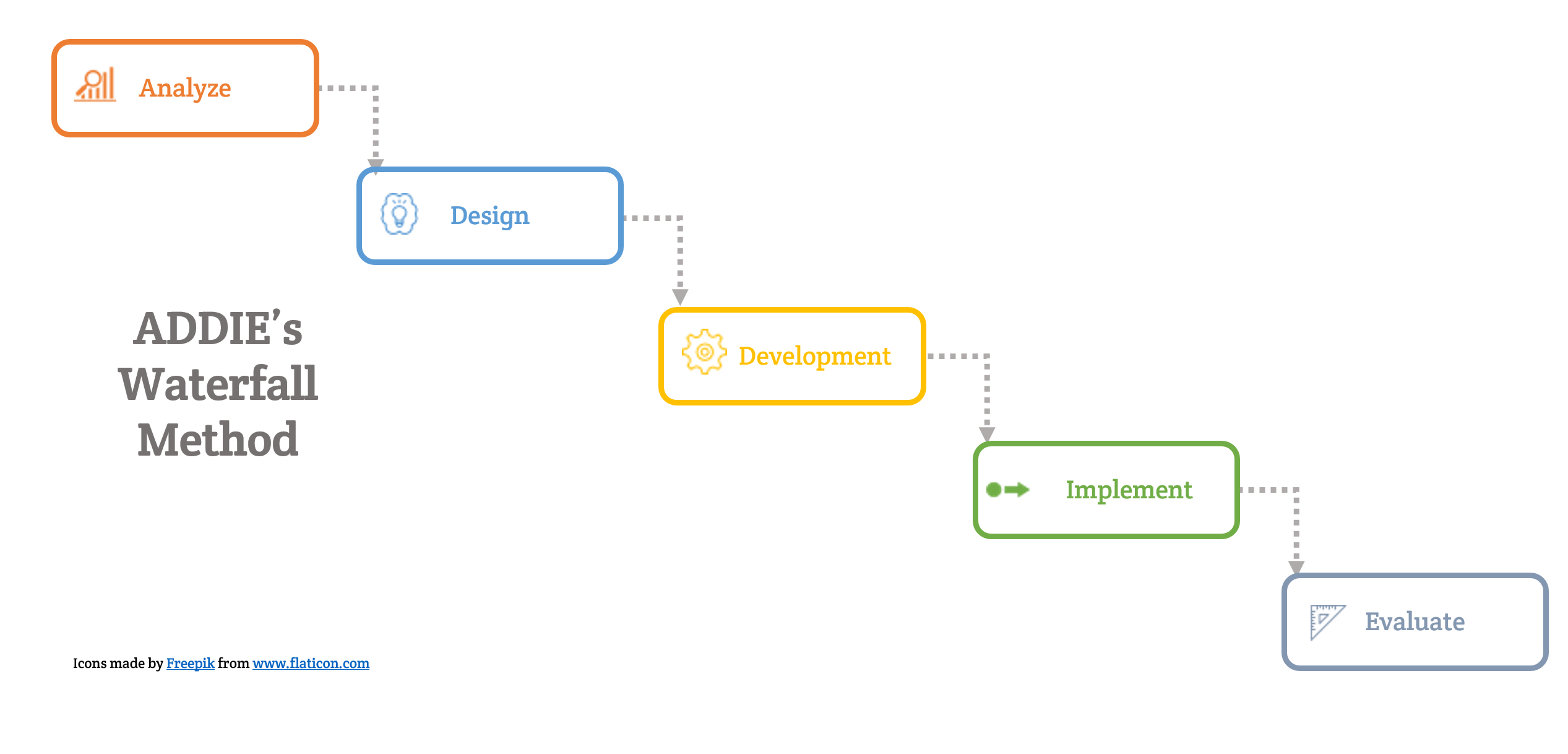
I just started a program on instructional design. Creating this glossary is my first assignment. This glossary will obtain 25 key terms from The Essentials of Instructional Design Book by Abbie H. Brown and Timothy D. Green.
ADDIE Model
This popular design model is a systematic approach. A production line that consist of ordered steps (Analyze, Design, Development, Implement, Evaluate).
Analysis
First thing an instructional designer should do is get an idea of the who, what, where, and why of the instruction in order to analyze how to development and deliver the content.
Audience Analysis
Identifying who you're training, what they already know, and how to communicate with them. Knowing your audience will guide the decisions you make when it comes to how and what content to present.
Behaviorist Perspective
The perspective or belief that the human mind is capable of being shaped and formed into producing desired responses.
Design
Start with a clear plan of how everything in the course will be laid out and how the text, multimedia, and navigation will fit together.
Development
Build out your learning content to meet the needs of the audience and learners.
Educational Psychology
This refers to how the learner learns and the science of designing instruction. Instructional Design descended from this concept.
Evaluation
Evaluation is when you use the specific performance improvements created in the analysis phase identify the results. To evaluate course effectiveness you can either measure the numbers of the Key Performance Indicators (KPIs) or use a survey to measure the satisfaction or use of skills of your learners.
General Systems Theory
Explains the common elements of the theoretical constructions of the various scientific disciplines. Explains how systems work, regardless of the specific setting.
Implementation
Sharing it with your learners in an effective and engaging way.
Instructional Design
Instructional Design is the linking science that applies logic and scientific methods to the problems involved in designing and developing instruction.
Kemp, Morrison, and Ross's Instructional Design Plan
A design plan that consists of 9 elements and that is not illustrated as a specific sequence, instead it is presented in an oval pattern because each element may be addressed at any time while developing instruction.
The nine elements consist of Identifying problems and goals, examine learner characteristics, identify subject content and analyze task components, specify objectives, sequence content, design strategies, develop instruction, assess objectives, select resources to support learning activities.
Learning Management Systems (LMS)
A tool that allows you to distribute e-learning courses to your learners and track their activity.
Merrill's Pebble-in-the-Pond Model
This model articulates six design phases; design a problem, design a progression of problems, design instruction for component skills, design instructional strategy enhancements, finalize instructional design, and design assessment and evaluation. This model avoids creating objectives before developing instructional content because Merrill maintains they tend to change as the instruction is developed.
Positivistic Worldview
Any problem has only one correct answer.
Postmodernism/Postpositivistic
Any one problem may have a number of different correct answers depending on the worldview of the person attempting to derive the answer.
Rapid Prototyping
This approach does not follow the traditional systems process of design and development. It is a developmental approach in which one arrives at a final product through the creation of a number of prototypes. Then, each prototype is evaluated by experts and users arriving to the final product.
Scope Creep
Scope creep refers to changes in a project's scope after the project begins.
Storyboard
A way to deliver e-learning content.
Storyboard
A document that delivers instruction for an e-learning project. Tools used to create a storyboard can vary between PowerPoint to Word to Articulate Storyline.
Subject Matter Expert (SME)
A subject matter expert is the person that an instructional designer interviews and collaborates with on the content of what is to be learned. An SME is the expert of the content.
Successive Approximation Model (SAM)
This design model is a cyclical process with three design steps of evaluation/analysis, design, and development. It is best for smaller projects that don't require complicated technology.
Task Analysis
A task analysis breaks down the tasks a learner needs to do and shows learners the steps they need to follow to complete the task successfully. This identifies all of the physical and mental steps learners must go through to complete each identified task. (Nicole Legault Instructional Design Basics, Articulate 360)
The Systems Approach Model for Designing Instruction
This traditional approach of presenting information through lecture, textbook reading, review, and testing and places the burden on the learner to do the best they can with the content. Little thought is given to adjusting or improving instruction based on the learner.
Training needs analysis
After identifying the performance gap, determine if its a training needs analysis. This training will provide knowledge and skills.